When to trade: the four forex sessions and the overlap that matters
Forex trades 24 hours a day, five days a week — but it does not trade well for all 24. Each session brings its own banks, its own volume and its own personality, and the differences are practical, not academic: spreads, slippage and how far price travels all depend on the clock. Here is the map beginners actually need.
The four sessions on one clock
All times below are UTC and shift by an hour around daylight-saving changes — treat them as the shape of the day, not exact gate times. Sydney opens the week quietly, Tokyo sets up yen and AUD pairs, London carries the heaviest volume of any session, and New York overlaps London for a few hours that behave like a different market.
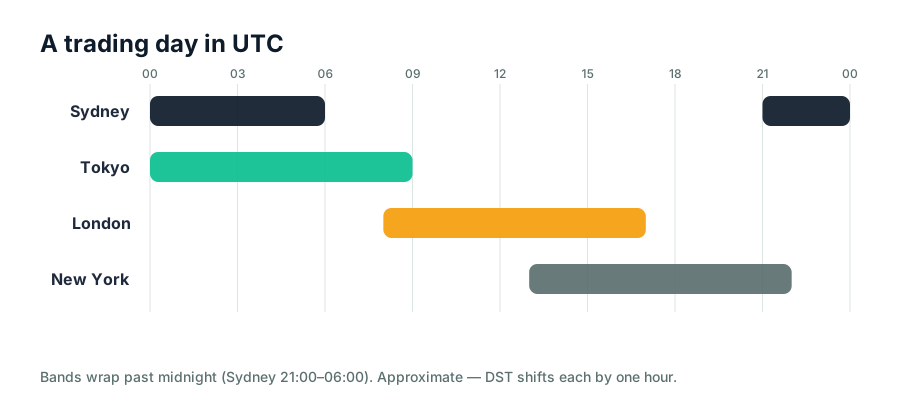
The London–New York overlap
Between roughly 13:00 and 17:00 UTC, the two largest financial centres trade at once. This window carries a large share of the day’s volume, which shows up in three ways you can feel: spreads on major pairs sit near their tightest, breakouts from the European morning often follow through, and reversals that start here tend to have real fuel. If you can only trade a few hours a day around a job, this is the window most beginners should default to.
Spreads by time of day
The spread is the most honest measure of liquidity — when banks are away, the gap between buy and sell widens and your entry starts further underwater. Typical figures for EURUSD look like this. The rollover spike around 21:00 UTC is famous: spreads can widen to several times normal for a few minutes, and stops set carelessly get brushed by them.
Matching the session to the pair
Trade currencies when their home banks are awake. JPY pairs move most in Tokyo (and again in the overlap), EUR and CHF pairs come alive in London, and USD pairs get their second wind in New York. Trading EURJPY in the Sydney afternoon means trading the crossover of two thin markets — moves are choppy and spreads are wide. A quick scan of live forex charts before a session opens tells you more than any table.
Typical EURUSD spread by time of day (UTC)
| Time (UTC) | Session | Typical EURUSD spread |
|---|---|---|
| 08:00–17:00 | London | ≈ 0.8–1.2 pips |
| 13:00–17:00 | London + New York overlap | ≈ 0.8–1.5 pips |
| 00:00–09:00 | Tokyo | ≈ 1.2–2.5 pips |
| 21:00–23:00 | Rollover / Sydney open | can spike to 3+ pips |
Quick answers — When to trade
Is the London session the best time to trade?
For most majors, yes — it combines depth with clear intraday trends. But “best” depends on your pairs and strategy: JPY strategies often test better in Tokyo, and NY data releases create their own opportunities for calendar-based traders.
Why do my trades cost more at night?
Fewer banks are quoting, so the gap between bid and ask widens to compensate. Paying a 3-pip spread to enter a trade that targets 10 pips hands a third of your prize to the door — often the difference between a winning and losing month.
Does the daily open matter?
Yes for two practical reasons: rollover (swap charges and spread spikes around 21:00–22:00 UTC) and the fact that many intraday strategies anchor levels to the London open. Check the economic calendar for release times too — they briefly dominate whatever session they land in.
Keep exploring on PipAtlas — When to trade
_Sources: BIS Triennial Central Bank Survey — FX turnover — reference material; PipAtlas is education only, never financial advice._
Related reading — When to trade
- Pip values explained with real trade examples — What a pip is actually worth on EURUSD, USDJPY and gold — with four worked trades showing why the same 20-pip stop is…
- How to read an economic calendar without blowing up on news days — CPI, NFP and central bank decisions explained for beginners — what the numbers mean, which ones move markets, and how…
- How to check a forex broker before you deposit — A ten-minute checklist: regulation tiers, segregated funds, withdrawal rules and the red flags that separate serious…